
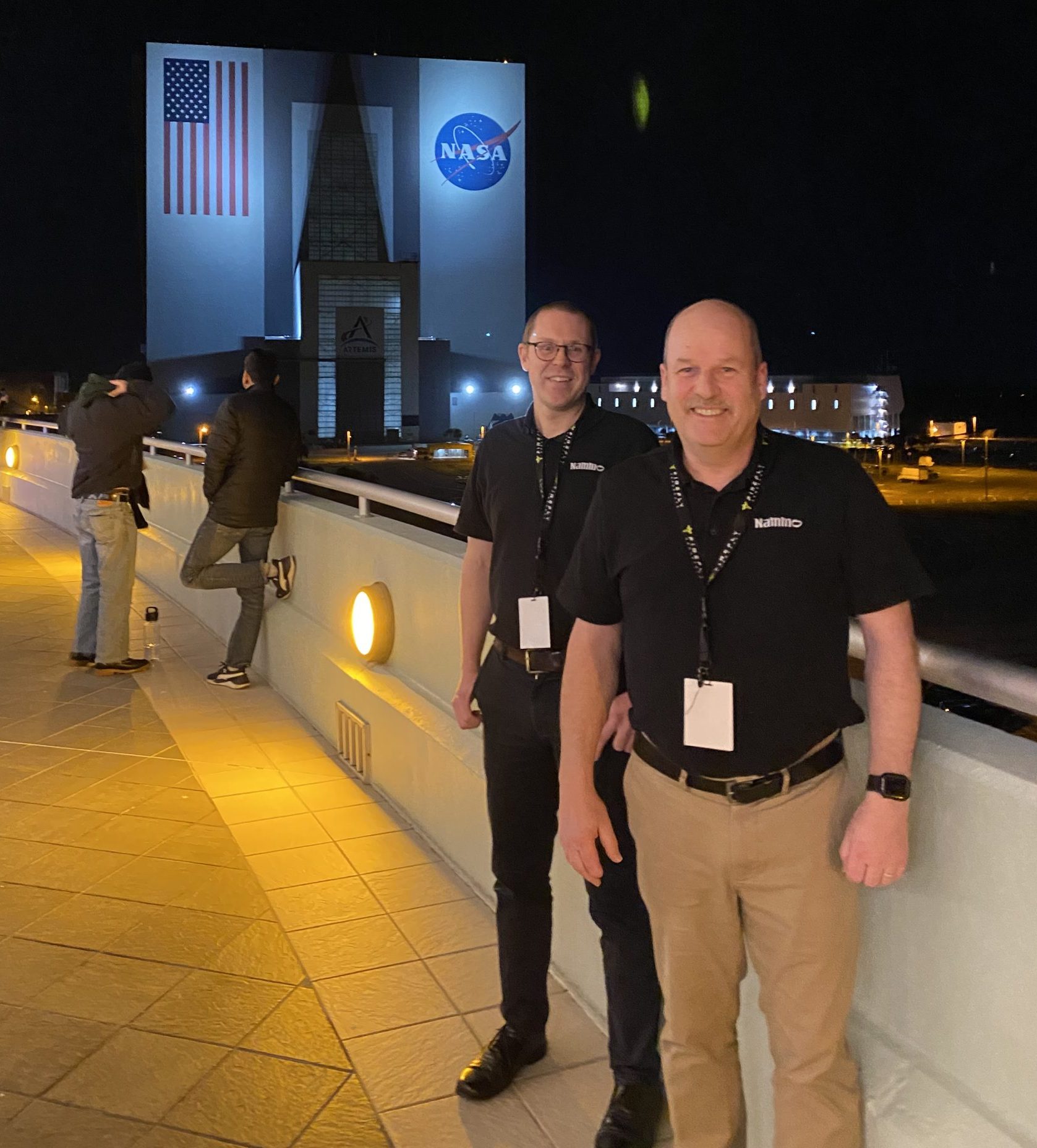
Ian Coxhill (chief engineer, left) and Adam Watts (business and strategic development manager, right), watched the Blue Ghost mission launch at Cape Canaveral, Florida, on January 16, 2025. Photo: Nammo
Written by Jade Bell, Nammo
On Sunday 2nd March 2025, Firefly’s Blue Ghost became the first commercial lunar lander to successfully land on the moon! This wouldn’t have been possible without Nammo UK’s LEROS 4-ET as the main engine.
In 2011, the European Space Agency and the UK Space agency were looking for a company to develop a high-thrust apogee engine (HTAE). Despite being a much smaller company at the time, Nammo UK won the contract and began developing the new engine for them.
Fast forward to 2021, Firefly Aerospace approached Nammo UK in search for an engine capable of landing their Blue Ghost Lunar lander on the moon. Thanks to the development of the HTAE, Nammo UK were well equipped to meet Firefly’s needs leading to the creation of the LEROS 4-ET (Extended Thrust).
The LEROS 4- ET was designed, manufactured and tested at Nammo’s Westcott and Dublin sites by their highly skilled team. What makes this engine unique is that the very first unit built went straight to flight following a highly successful series of tests.
The engine was tested on site in Nammo UK’s vacuum test facility, a capability made possible with the support of the UK Space Agency’s National Space Propulsion Test Facility. The collaboration between these two sites allows the team to simulate the conditions in space under vacuum.
Before doing its final burn the LEROS 4 had to complete a series of other manoeuvres to get to that point. On February 9th 2025 it completed its trans-lunar injection burn, which accelerated Blue Ghost to a velocity sufficient enough to escape Earth’s gravity and enter free space towards the moon. Approximately 4 days later, the four minute long lunar orbit insertion burn occurred to slow Blue Ghost sufficiently for capture into lunar orbit.
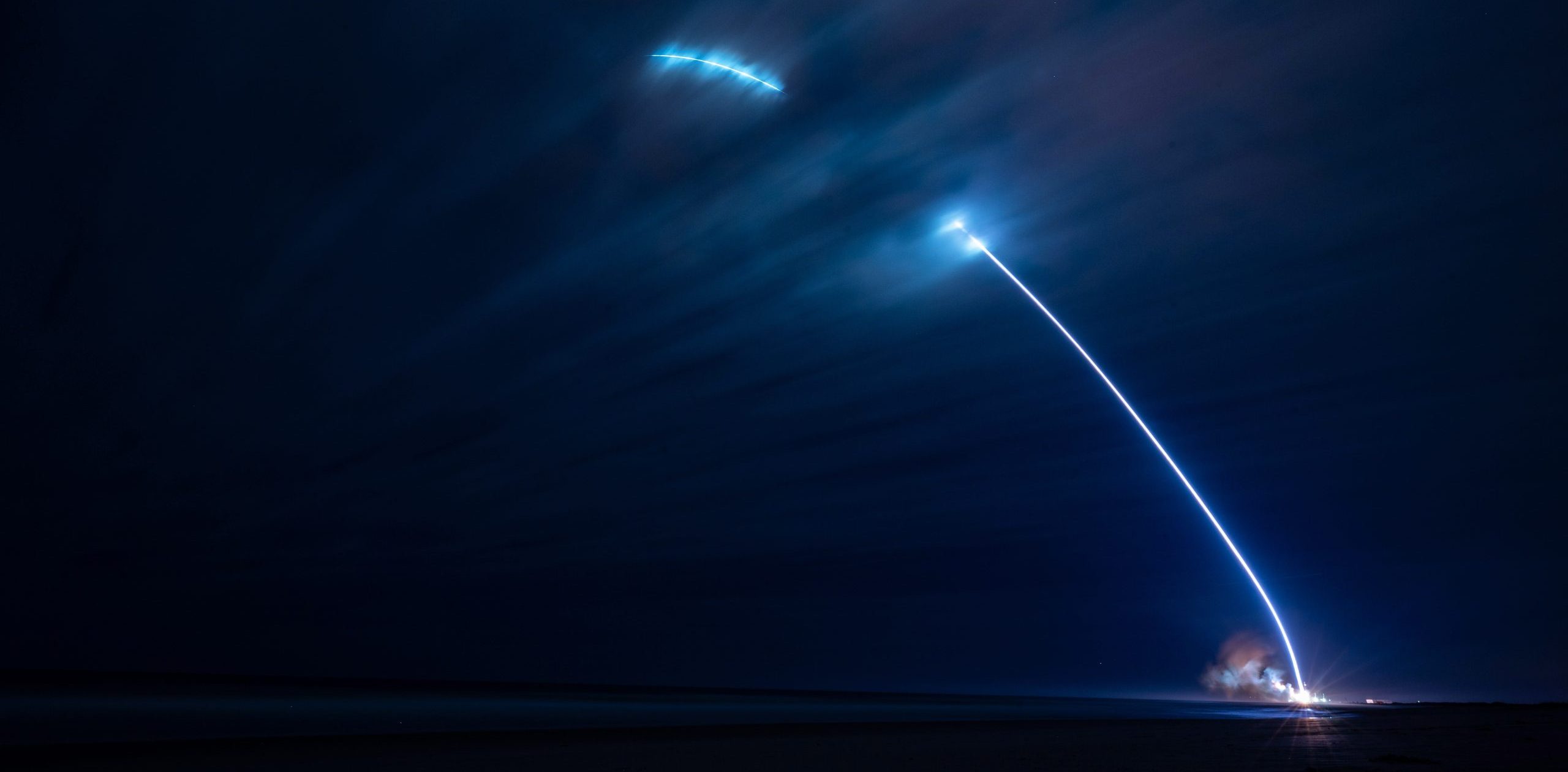
The Blue Ghost mission launched from Cape Canaveral, Florida, on January 16. Photo: Air Force Senior Airman Samuel Becker / USAF
The LEROS 4 performed its longest burn yesterday. This was the descent orbit insertion burn, lasting approximately 550 seconds, that was critical to the successful landing of Blue Ghost working in conjunction with Firefly’s 200 Newton engines on the perimeter of the spacecraft.
Ian Coxhill, Chief Engineer at Nammo UK, explained ‘once in lunar orbit, the LEROS 4 reduced the majority of its velocity to slow down enough for descent onto the Moon’s surface. When Blue Ghost was close to the lunar surface, the LEROS 4 switched off, as most of the on board propellant had burnt off. At this point, the spacecraft was significantly lighter allowing the smaller engines to complete landing safely.’
Nammo UK would like to thank the UKSA and ESA for the success of the LEROS 4 as it would not have been possible without their support in the development of the engine. The UK Space Agency’s test facility has enabled the testing of the engine and will be used for ESA’s Envision mission to Venus to qualify the engine for flight.

